
Being a freelancer: what recruiters think you do vs. what you actually do.
This is no secret that I’m actively looking for a job — as of right now at least. And in a few interviews I’ve recently landed, a recurrent “question”, not to say an obvious concern, came up from my interviewers once in a while. It encouraged me to write a few words describing the hidden side of running a small business…
Tl; dr: waste no time, just get in touch and hire me :-)
“So, I can see you’re working as freelancer for more than 3 years now, aren’t you afraid of getting back to a corporate life?” is the most common way I’m asked. Although subtle, it often underlines a bit of a concern in the recruiter’s voice. Occasionally, the question is turned quite more frankly: “there would be things like… you’d have to be at 8am in the office and respect some offices rules, you know”, or “you will have direct synergies with your coworkers around and often face customers”, as if I was a lazy, mad, sectarian antisocial.
Don’t get me wrong, I’m not criticizing my past / future interviewers here, and I can’t blame them for trying to tickle me on any potential vulnerability that could matter for the position. I’ve been sitting in this recruiter chair, too. I always take this matter with understanding and a bit of amusement, detailing how running a small business is what you can consider a real job and why it’s probably more demanding that some could guess — except maybe for those who’ve been on this dark side too. It’s just frustrating when the person in front obviously doesn’t seem to believe you.
Talking with folks from the same line of business, I discovered this was somehow quite a recurring concern most of them often faced when switching back to an employee status after having been a freelancer, or simply when talking with their relatives. On the other hand, it’s time to enlighten this common bias.
The common cliché seems to describe the typical freelancer as someone who wakes up at 10am, stacks up coffee cups until mid-afternoon while procrastinating on the Internet, then does modify a bit of code on a customer’s website between 4 and 5pm and charges him up a full 8-hours day of consulting, then finishes the day playing ping-pong with his cool mates in a cool coworking space.
Spoiler: I wish!
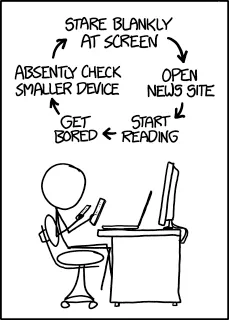 What people think freelancers do. Source: https://xkcd.com/1411/
I started my first assignment as an independent back in March 2015. Then everything went on so fast until today. Some billable side-projects, then later business development for a danish start-up with an office in Zürich, a few months later I was opening a Ltd company specialised in Digital Marketing, especially 360° & VR content creation and local SEO. I sold my shares a few months ago to focus on a few customers as a freelancer and later get back to a corporate position, and I have overall been what one could call a small business owner, entrepreneur or independent, full time since 2015.
Over this time, I accomplished so much more than I would have guessed: handovered +40 projects and +150 single deliverables, sourced a 10–12 people team of specialists in sales / photography / video shooting & post-editing / digital marketing & SEO / web development / VR & 3D objects / Facebook Ads or Google AdWords, to support my business development or strengthen my core services.
These are just figures for the global picture. What these numbers don’t say is, although your CV may obviously say “independent consultant” and “company owner”, that what you really are is a blend of everything at the same time:
- You’re an accountant, having your eyes permanently on the cash flow and the overall financial health of your business. This is actually the most intimidating Sword of Damocles you have above your head every day and what you should be the most concerned about. Every other segment of your business has no value if you don’t properly control your finances or, worse, if you simply don’t have enough cash pouring in. Every day checking the sales pipeline and forecasts, controlling expenses, dealing with the fiduciary, claiming your money to your overdue customers — surprise, there are a lot of the latter! Generally speaking, you track and register every bit of cash in and out and in the end, you won’t pay yourself so much anyway;

- You’re an HR, from A to Z: thinking out the whole recruitment process, creating inventive job ads designs & content, publishing, collecting, interviewing, networking to hunt profiles from other sources, making job offers, maintaining documentation storage and quality, dealing with relevant authorities for the compensation, health insurance contribution or taxation issues. It also includes you have to let good people go or worse, to terminate some peoples contracts, hopefully not that often but that’s never a pleasure;
- You’re of course an operations/project/account manager and 24/7 salesman: lead sales, animate the weekly meeting with your staff dispatched accross Switzerland, follow up on quotes, train new ones to your products/services/tools, and join them on the field for all their firsts appointments, take on critical hot leads, overlook planification and progress of every project and write or check specs for all of them, translate customers vision to functional specifications, supervise each piece of deliverable, ensure the offshore developper maintains quality and deadline, and so on… Still floating, but we’re not finished with your assignments, yet.

- You’re the marketing & communication manager: this one’s perhaps a bit easier to me, at least more natural, since marketing is my core background. You have to define your positioning and strategy, do some competitive intelligence — at least in your close business area — and attend exhibitions, design and order the rollups for your booth, write or review all content from slides or every customer presentation, etc. There’s not a single piece of visual or textual content intended to go public that doesn’t pass through your own small QC.
- You’re also kind of a digital and tech lead: do you go local or SaaS? which one? which infrastructure? which price? Let’s go for a quick procurement analysis then review, test, compare, chose. Any software, security or technical solution you wish to implement to help you leverage your business, from your initial choice of an ERP (note to myself: plan a detailed article about Podio, an awesome project management solution by Citrix) or CRM, or which on-the-fly solution your salesmen will use on their tablets on the field. That was quite fun too since I’m passionate about it and I always enjoy trying to tweak out things for more productivity, such as automating the creation & sending of an invoice in Xero when a customer signed the offer in the digital quote management app, or automatically triggering tasks to relevant people when a lead status turns from “negotiating” to “closed” in the CRM;
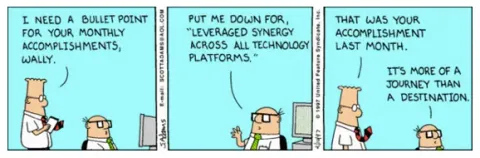 Digital joke —pardot.com
- Then you’re also a bit of an extremely versatile Swiss-army knife for plenty of other miscellaneous tasks: you’re the webmaster of your own website, the web developer of most of your customers’ websites, the 1st graphic designer of your overall branding and own logos, the secretary of all your administrative correspondence, the receptionist of your business phone. You also read, a lot. About latest trends, technology, digital, SEO, competitors, and have to permanently stay up to date.
So you’re all of the above, at the same time. Without — or even with — a deep (re)thinking of your own organisation, some days will inevitably tend to be quite overwhelming and you’ll don’t even know where to start.
Avoid panicking.
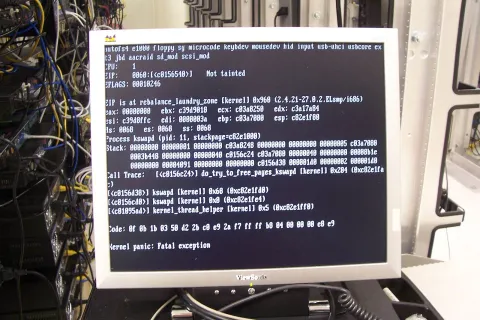 Kernel panic - CC BY 2.0 - Wikipedia.
Finally, between all these, or early in the morning / late at night, comes the arguably best part (or at least less problematic) that you enjoy even more: working and delivering projects to your customers and giving it your best.
“Working on your own business exposes you to things at a rate faster than you could ever get at a big company. Even if it doesn’t work out, which most likely it won’t, many employers value this experience.” Daniel Sangyoon Kim on Medium
Then yes, indeed, to answer “The Question”, sometimes I wasn’t “ready to work at 8am”… probably because these days I was already up and working at 5am either because I felt like it — I find it relatively more productive to wake up early in the summertime and contrarily, to work late in the evening in wintertime — or due to some random issue that was keeping me awake, or because I was already hitting the road to attend a meeting in Geneva, Lausanne or Zürich. Not saying I’ll never go back to a freelancer position, since the job market has evolved so much lately — not necessarily positively but that’s for another day— but for now I’m looking for a change.
I spent more than 3 years mostly working home office with remote colleagues spread accross the country or abroad, and while I do like my office, I simply may have experienced an exhaustive tour of what running a small digital marketing business is like. I may be tired of running after every late/bad payer, having revenues go up and down as projects go by, tired of living in uncertainty. Perhaps welcoming a newborn last year has been a gamechanger in my mind, making me looking for more stability in terms of work plan and income.
When I think about it, what I’m also sure of, is that I will have considerably grown from this experience although I still have a lot more to learn, and that what I like and look for right now in bigger companies is that when you launch/work on a project you do have much consequent budgets, targets and teams to work with, and this helps you to achieve & deliver bigger, personally-rewarding projects. It’s more exciting.
Excitment, I guess, is what I need after all.